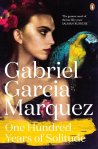
“One of the world’s most famous novels, One Hundred Years of Solitude by Gabriel Garcia Marquez, winner of the Nobel Prize for Literature, blends the natural with the supernatural in on one of the most magical reading experiences on earth.
‘Many years later, as he faced the firing squad, Colonel Aureliano Buendia was to remember that distant afternoon when his father took him to discover ice’
Gabriel Garcia Marquez’s great masterpiece is the story of seven generations of the Buendia family and of Macondo, the town they have built. Though little more than a settlement surrounded by mountains, Macondo has its wars and disasters, even its wonders and its miracles. A microcosm of Columbian life, its secrets lie hidden, encoded in a book, and only Aureliano Buendia can fathom its mysteries and reveal its shrouded destiny. Blending political reality with magic realism, fantasy and comic invention, One Hundred Years of Solitude is one of the most daringly original works of the twentieth century.“
by Gabriel Garcia Marquez (Author), Gregory Rabassa (Translator)
Gabriel García Márquez (1927 – 2014) was born in Colombia and was a Colombian novelist, short-story writer, screenwriter and journalist. His many works include The Autumn of the Patriarch; No One Writes to the Colonel; Love in the Time of Cholera and Memories of My Melancholy Whores; and a memoir, Living to Tell the Tale. He was awarded the Nobel Prize for Literature in 1982.
first shown in 1992, set an auction high for a living female artist when it sold for 9.5 million pounds, or about $12.4 million, at Sotheby’s “Frieze Week” evening sale of contemporary art.
She should have been the center of attention, but somehow everyone got distracted.
The nude self-portrait “Propped,” by Jenny Saville, was bought by a telephone bidder at Sotheby’s on Friday night for 9.5 million pounds, or about $12.4 million. That should have made plenty of headlines: The price paid for the work, part of the “Sensation” show of Young British Artists that caused such a stir in London and New York in the late ’90s, was a new auction high for a living female artist.
The result, more than three times the low estimate, was acclaimed in the salesroom with a huge round of applause. But before anyone had time to reflect on its significance, Banksy’s $1.4 million “self-destructing” painting intervened, and the world was talking about a sensational stunt, rather than the way that female artists, and artists from other long-disempowered sectors of society, were reconfiguring the art world.































 likeanantennastraighttoheaven